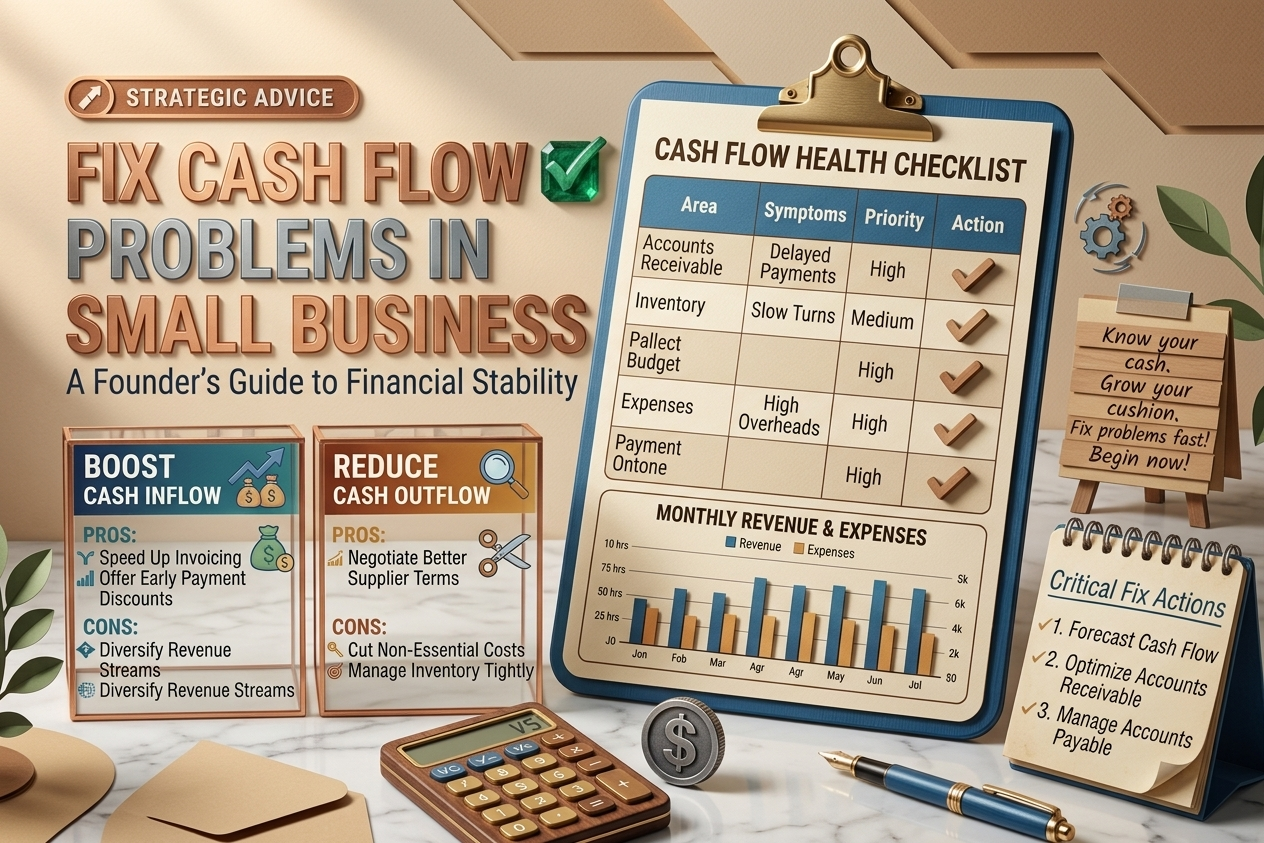
Here is the part that surprises many owners: your business can be busy, fully booked, and still run out of cash. That is what cash flow problems feel like in real life. Revenue looks fine in a slide deck. The bank account tells a different story. Payroll is close. A client is late. A software bill hits. Suddenly you are dealing with cash flow problems instead of doing the work that grows the company.
Small business cash flow problems are not always a sales problem. More often they are a timing and systems problem: invoices go out late, hours never become bills, expenses arrive before payment, and nobody sees the gap until it hurts. This guide focuses on how to fix cash flow problems with clear diagnosis, step-by-step solutions, and examples from freelancers, agencies, and small service teams.
You will get direct answers, a map of common cash flow problems, fixes you can run this month, best practices, mistakes to avoid, and FAQs. The goal is practical: how to improve cash flow in small business without pretending a motivational quote will clear your runway.
What are cash flow problems? (Direct answer)
Cash flow problems are periods when cash leaving the business exceeds cash coming in over a given window. Profit can still look healthy while cash is tight, because profit is an accounting result and cash is what pays vendors, payroll, and rent today.
- Cash in: client payments, retainers, deposits, recovered receivables
- Cash out: payroll, contractors, tools, ads, rent, taxes, inventory
- The gap: timing mismatches between delivery, invoicing, and payment
Why small businesses get cash flow issues
Cash flow issues small business teams face usually come from a short list of operating patterns — not from “not working hard enough.”
- Invoicing only at month-end while expenses hit weekly
- Untracked time that never becomes invoice line items
- Clients on long payment terms with no deposits
- Scope creep that burns hours without a change order
- Tool and contractor spend that scales faster than collections
- No rolling forecast, so surprises feel like emergencies
If that list feels familiar, you are not alone. Cash flow pressures for small business owners are common in service businesses precisely because delivery and billing often live in different tools.
How to diagnose business cash flow problems in one week
Before you cut everything or take a loan, diagnose. Guessing creates the wrong fix.
- List cash in and cash out for the next 13 weeks (even a spreadsheet is fine).
- Mark invoices sent, invoices overdue, and work completed but not billed.
- Highlight expenses that are fixed versus optional.
- Name the top three leaks: late billing, slow collection, overspending, or underpricing.
- Pick one leak to fix this week and one structural fix for this month.
Example: A five-person agency discovered $18,000 of finished work sitting unbilled while they argued about “slow sales.” Sales were fine. Billing was late. That is a classic cash flow issue dressed up as a growth problem.
Common cash flow problems and how to fix them
Use this problem-solution list as your operating playbook. Each item includes steps and a workplace example.
1. Problem: Invoices go out too late
If you wait until month-end to bill, you donate float to your clients. Cash arrives weeks after the work — while payroll does not wait.
Solution steps:
- Invoice weekly or at milestone completion, not only on the last day of the month.
- Build invoices from tracked time and deliverables instead of memory.
- Set a same-day rule: when a milestone ships, the invoice draft starts.
- Automate reminders for overdue balances.
Example: A freelance design studio moved from monthly batching to weekly invoices. Average days-to-pay dropped because clients still remembered the work. For connected billing, invoice management that pulls from time entries reduces the rebuild tax that delays cash.
2. Problem: Hours are worked but never billed
Unlogged calls, “quick” revisions, and missing timers create invisible write-offs. That is one of the most expensive small business cash flow problems because it looks like loyalty while it drains runway.
Solution steps:
- Track time on tasks under the right client.
- Review unbilled hours every Friday.
- Decide: bill, write off with a reason, or convert to a change order.
- Tighten the brief so free revisions do not become a habit.
Example: A consultancy found 12% of weekly hours never reached invoices. They started task-based timers and a Friday unbilled review. Cash improved without a single new client. See time tracking when the leak is operational, not motivational.
3. Problem: Clients pay slowly (or not at all)
Net-45 and net-60 terms can crush a small firm. Dealing with cash flow problems here means changing terms and collection habits — not hoping harder.
Solution steps:
- Require deposits on projects above a set size.
- Offer a small discount for early payment if margins allow.
- Send polite, scheduled reminders at 7, 14, and 21 days overdue.
- Pause non-critical new work for chronically late accounts.
- Keep unpaid balances visible in one place — not buried in email.
Example: An agency added 40% deposits on projects over $5,000. Cash flow pressures for small business owners on that team dropped because kickoff cash arrived before the heavy delivery weeks.
4. Problem: Expenses scale before revenue lands
Hiring, ads, and SaaS stacks often grow on optimism. Cash does not. Business cash flow problems show up when spend assumes next month’s wins are already in the bank.
Solution steps:
- Freeze non-essential subscriptions for 30 days and reinstate only what you miss.
- Tie new contractor spend to signed, deposit-backed work.
- Separate “growth bets” from “must-pay” operating costs in your forecast.
- Review tool spend monthly with one owner accountable.
Example: A startup studio cut five overlapping tools and kept one work system plus a docs tool (Notion for SOPs). Monthly burn fell without hurting delivery — because the stack was noise, not leverage.
5. Problem: Retainers and projects are underpriced
If hours routinely exceed what the fee covers, you are funding the client. That creates chronic cash flow issues even with a full roster.
Solution steps:
- Compare hours per client against revenue per client each month.
- Flag retainers with rising effort and flat fees.
- Renegotiate scope or price with evidence, not vibes.
- Add change-order language for out-of-scope requests.
Example: A media-buying freelancer tracked time for six weeks and found one “easy” retainer consumed three times the assumed hours. They repriced. Cash stopped leaking. Pair this with clearer client records via client management so margin conversations stay factual.
6. Problem: No cash forecast, only gut feel
Gut feel is not a treasury system. Without a forecast, every surprise feels like a crisis — and crises create expensive decisions.
Solution steps:
- Build a simple 13-week cash view: opening balance, expected inflows, expected outflows.
- Update it every Monday in 20 minutes.
- Mark weeks where the balance dips below your safety number.
- Act early: accelerate invoices or delay optional spend before the dip.
Example: A coaching business saw a low-cash week three weeks ahead because two renewals landed after rent. They invoiced renewals earlier and avoided a panic transfer from personal funds. That is how to improve cash flow in small business with visibility, not heroics.
7. Problem: Delivery and billing live in different worlds
Boards in one app. Timers in another. Invoices in a third. Reconstruction delays cash. Connecting the loop is often the highest-leverage fix for service firms.
Solution steps:
- Put clients, projects, tasks, and time in one system of record where possible.
- Generate invoice drafts from tracked work.
- Review unfinished billable work weekly.
- Retire duplicate trackers that create conflicting “truths.”
Example: An agency stopped rebuilding invoices from screenshots and chat. They billed from task time instead. Invoice day shrank from a scramble to a review. Aenflow is built for that client → project → task → time → invoice path — see agency workflows and freelancer workflows when your stack fights collections.
A 30-day plan for how to fix cash flow problems
- Week 1: Build the 13-week forecast and list all overdue invoices. Collect hard.
- Week 2: Invoice all completed-but-unbilled work. Start weekly billing cadence.
- Week 3: Add deposits for new projects. Cut unused tools. Review hours vs fees.
- Week 4: Connect delivery tracking to invoicing. Set a recurring Monday cash review.
By day 30 you should have clearer visibility, fewer unbilled hours, and a faster path from finished work to cash in the bank.
Best practices for healthier cash flow
- Separate profit conversations from cash conversations — track both.
- Invoice closer to the work while details are fresh.
- Keep a cash reserve target (even a small one beats zero).
- Review receivables weekly, not when panic hits.
- Price with hour data, not hope.
- Write payment terms into proposals before kickoff.
- Make one person accountable for collections follow-up.
Common mistakes when dealing with cash flow problems
- Assuming more sales alone will fix timing gaps.
- Taking on low-margin work just to “cover cash” without a plan.
- Ignoring unbilled work because it feels awkward to invoice.
- Letting chat replace a real invoice and payment tracker.
- Cutting growth investments randomly instead of reading the forecast.
- Mixing personal and business cash until neither is clear.
- Waiting for a crisis before changing payment terms.
Frequently asked questions
What are cash flow problems in a small business?
Cash flow problems happen when money leaving the business outpaces money arriving — even if you are profitable on paper. Common triggers include late invoices, slow-paying clients, uneven project timing, and expenses that hit before revenue lands.
How to fix cash flow problems quickly?
Start with a 13-week cash forecast, collect overdue invoices this week, delay non-critical spending, and invoice closer to delivery. Those four moves often ease cash flow pressures for small business owners within 30 days.
How to improve cash flow in small business without a loan?
Tighten billing cadence, require deposits on larger jobs, track time so invoices are complete, reduce WIP that never bills, and cut subscriptions you do not use. Financing can help, but operations usually fix the leak first.
What are common cash flow problems for freelancers and agencies?
Unbilled hours, month-end invoice piles, retainers that underpay for effort, clients on net-60 terms, and buying tools before cash arrives. Dealing with cash flow problems in service businesses usually means connecting delivery to invoicing.
When should I worry about business cash flow problems?
Worry when you regularly delay supplier payments, cannot cover payroll without personal funds, or need every new deposit to pay last month’s bills. That pattern means cash flow issues small business owners should treat as urgent operations work.
Conclusion: fix cash flow problems with an operating system
Cash flow problems rarely vanish because you “try harder.” They shrink when you diagnose timing gaps, bill finished work faster, collect with a rhythm, control spend against a forecast, and connect delivery to invoicing. That is how to fix cash flow problems in a small business for real — not as a one-time scramble.
Pick one leak this week: overdue invoices, unbilled hours, or a missing forecast. Fix it visibly. Then add the next fix. Cash flow issues become manageable when they are measured and operated — not feared.
If your cash gets stuck between delivery and billing, bring clients, time, and invoices into one flow. Start a free Aenflow trial or see the demo. For related reading, see business productivity methods, invoicing guides, and pricing.