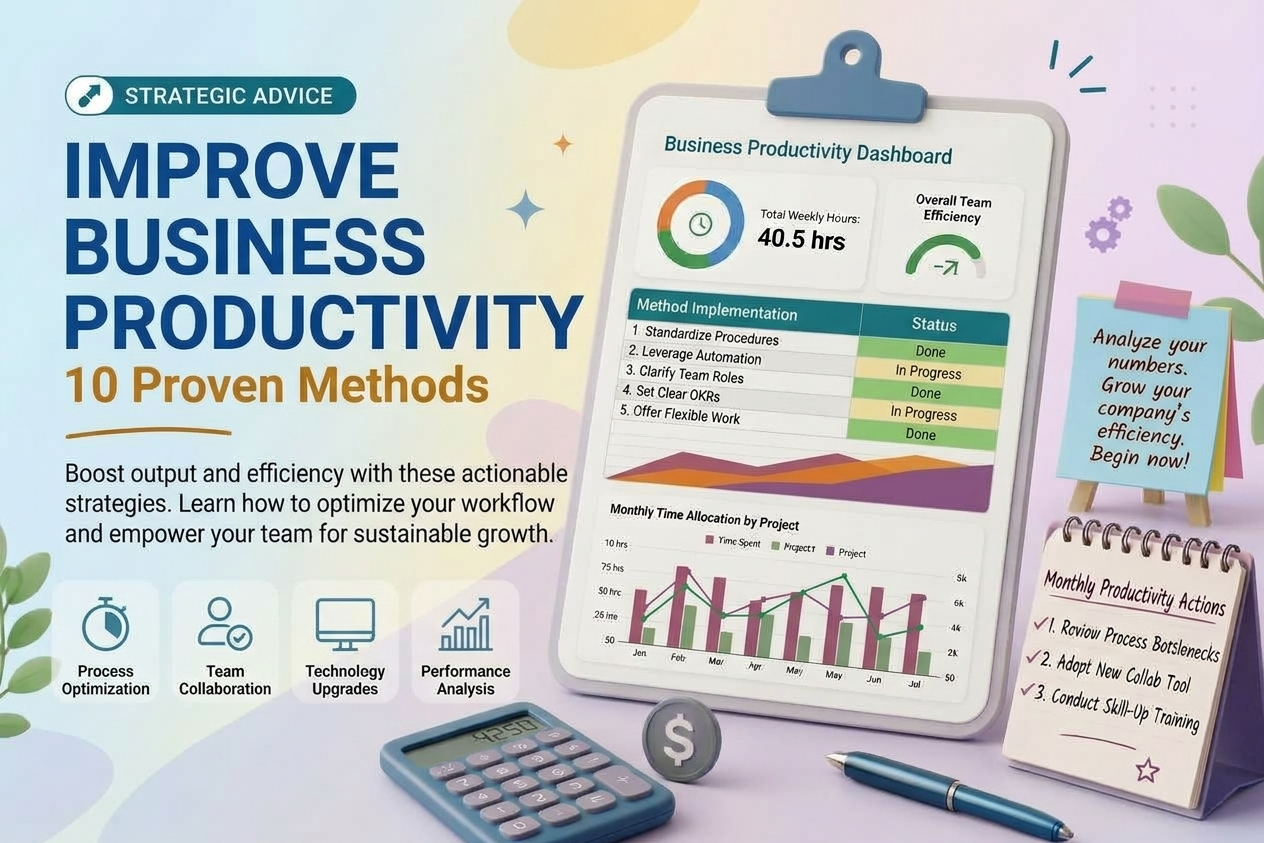
Most businesses do not have a motivation problem. They have a system problem. People work long days, jump between tools, sit through meetings that decide nothing, and still miss the outcomes that matter. If that sounds familiar, you do not need another vague pep talk about hustle. You need a practical way to improve business productivity where work actually happens.
Business productivity is the ability of a company to turn time, attention, and resources into valuable results. It is not the same as being busy. A team can look fully occupied and still produce little that clients, customers, or leadership can use. The goal is workplace efficiency: less wasted motion, clearer ownership, faster completion, and better quality.
This guide covers how to improve business productivity with 10 proven methods you can apply immediately. You will get step-by-step actions, real-world examples, best practices, common mistakes, and FAQs. Whether you run a small office, an agency, a consulting practice, or a growing team, these productivity strategies focus on output you can measure — not empty activity.
What business productivity really means
Business productivity improves when three things move together: clearer priorities, cleaner workflows, and measurable results. If only one improves, the gain rarely sticks. A company can buy new software and still drown in unclear requests. It can demand longer hours and still ship late because ownership is fuzzy.
A useful definition for teams is this: business productivity is completed work that advances a business goal, delivered on time, with acceptable quality, using the least necessary effort. That definition keeps “increasing productivity in the workplace” tied to outcomes instead of vanity metrics like messages sent or hours logged without results.
- Output: finished deliverables, closed tickets, shipped campaigns, completed client work
- Quality: fewer revisions, fewer errors, fewer handoff failures
- Speed: shorter time from “started” to “done”
- Cost of effort: less rework, fewer meetings, less tool-switching
10 proven methods to improve business productivity
Use these methods as a sequence when possible. Method 1 and Method 2 create clarity. Methods 3–7 remove friction. Methods 8–10 lock in measurement and improvement. Together they form actionable productivity tips for businesses that want results this month, not next year.
1. Define weekly outcomes, not endless task lists
A long task list creates motion. A short outcome list creates progress. If your team asks “what should I work on?” every morning, priorities are not clear enough to support company productivity.
Steps:
- Every Monday, choose 3–5 outcomes that would make the week a success.
- Attach one owner to each outcome.
- Break each outcome into the smallest set of tasks needed to finish it.
- Park everything else in a later list so it cannot compete for attention.
- Review Friday: what finished, what slipped, and why.
Example: An agency account team stops tracking 40 mixed tasks and instead sets three weekly outcomes: finalize Client A’s landing page, send Client B’s retainer invoice package, and close two open proposals. Task boards still exist, but they serve the outcomes. Within two weeks, status meetings shrink because progress is obvious.
This is one of the fastest ways to improve productivity in the workplace because it forces trade-offs. When everything is important, nothing is.
2. Make ownership visible on every piece of work
Unowned work becomes delayed work. Shared ownership sounds collaborative, but in practice it often means nobody is accountable. Workforce productivity rises when every active item has one clear owner, even when multiple people contribute.
Steps:
- Audit active work and mark anything with no single owner.
- Assign one accountable owner per task or deliverable.
- Define what “done” means before work starts.
- Require a next action and due date on blocked items.
- Escalate blockers within 24–48 hours, not at month-end.
Example: A consulting firm finds proposal revisions floating in chat with three people “helping.” They move each proposal into a project with one owner, a checklist, and a due date. Turnaround time drops because waiting for “someone” ends.
If your team manages client work across projects, a structured system like project management in Aenflow keeps ownership attached to clients and tasks instead of scattered messages.
3. Cut low-value meetings and replace them with written updates
Meetings are often the quiet tax on office productivity solutions. A 45-minute meeting with eight people costs six hours of collective attention. Some meetings are necessary. Many are habits.
Steps:
- List recurring meetings and their stated purpose.
- Cancel any meeting that has no decision, no unblock, and no review of outcomes.
- Convert status meetings into a written update with blockers only.
- Keep decision meetings short and end with owners and deadlines.
- Protect at least one daily deep-work block with no meetings.
Example: A 12-person operations team replaces a daily standup with an async board update by 9:30 a.m. They keep a 20-minute blocker huddle three days a week. Within a month, they recover more than five hours of focused work per person each week.
4. Reduce context switching with work batches
Switching between email, chat, design tools, and reporting destroys focus. Context switching feels productive because it looks responsive. In reality, it is one of the strongest drag factors on employee productivity.
Steps:
- Group similar work into batches: communication, deep delivery, admin, and review.
- Set 2–3 message-check windows per day instead of living in chat.
- Finish one task stage before opening a new tool when possible.
- Use do-not-disturb during protected focus blocks.
- Track interruptions for three days to see the real cost.
Example: A freelance-led studio batches client messages at 11:00 and 16:00. Designers get morning focus blocks. Response quality stays high, while delivery speed improves because work is no longer sliced into five-minute fragments.
5. Standardize recurring work with checklists and templates
If your team reinvents the same process every week, you are paying a creativity tax on routine work. Standardization is not bureaucracy when it removes decisions that do not need to be remade. It is one of the most reliable productivity improvement ideas for growing teams.
Steps:
- Identify work that repeats weekly or monthly: onboarding, reporting, invoicing, QA, publishing.
- Write a short checklist for each process.
- Create templates for briefs, proposals, handoffs, and status updates.
- Store templates where the work starts, not in a forgotten folder.
- Improve the checklist after every miss — not after every success only.
Example: A coaching business builds a client onboarding checklist: contract, kickoff questions, shared folder, first session agenda, and billing setup. New client launches that once took three chaotic days now finish in one afternoon with fewer missed steps.
Notion is useful here for SOPs and knowledge docs. For client delivery that must connect to billing, keep execution in a work system that already knows the client and project — so templates do not live disconnected from revenue.
6. Track time where the work happens
You cannot improve what you cannot see. Many teams guess where hours go and then wonder why deadlines slip. Time tracking is not about surveillance. It is about finding friction, underpriced work, and overloaded people.
Steps:
- Track time on tasks or projects, not vague categories like “admin.”
- Review weekly: which work consumed the most hours relative to value?
- Flag work that repeatedly exceeds estimates.
- Use the data to reprice, rescope, or redesign the process.
- Keep logging friction low so people actually do it.
Example: An agency discovers “small” revision rounds consume 18% of weekly hours. They introduce a revision policy and clearer briefs. Capacity returns without hiring. That is how to improve efficiency and productivity with evidence instead of opinions.
For client businesses, time tracking on tasks matters because hours should roll into invoices and capacity planning. Aenflow is built around that loop so tracking supports delivery and cash flow, not a separate timesheet chore.
7. Limit work in progress to finish faster
Starting more work than you can finish creates fake progress. Boards fill up. Everyone looks busy. Nothing ships. Limiting work in progress (WIP) is one of the best productivity strategies for companies that constantly feel behind.
Steps:
- Count active items per person and per team.
- Set a WIP limit (for example, 1–2 major active items per person).
- Finish or kill stalled work before starting new work.
- Make “almost done” items the first priority each morning.
- Review aging tasks weekly — anything idle for 7+ days needs a decision.
Example: A product marketing team caps each specialist at two active campaigns. Cycle time falls because people stop spreading attention across six half-finished launches. Throughput rises even though they start fewer items.
8. Create a single source of truth for work
Tool sprawl quietly destroys workplace efficiency. When tasks live in chat, files live in drives, notes live in Notion, and deadlines live in someone’s head, people spend energy searching instead of shipping.
Steps:
- Choose one system of record for active work ownership and status.
- Choose one place for long-form knowledge and SOPs.
- Choose one primary communication channel for decisions.
- Write a simple rule: “If it is not in the system of record, it is not assigned.”
- Retire duplicate boards and shadow spreadsheets.
Example: A remote services team had Trello for tasks, Google Docs for briefs, Slack for requests, and a spreadsheet for deadlines. They moved active delivery into one project system, kept Notion for SOPs, and banned new work requests that arrived only as chat. Search time dropped. Handoffs improved.
If your business sells client work, the system of record should understand clients, projects, tasks, and time together. That is where Aenflow fits for many freelancers and agencies: less reconstruction between delivery and billing. See agency workflows and freelancer workflows for how that looks in practice.
9. Run a weekly productivity review that forces decisions
Daily hustle without weekly reflection creates the same problems forever. A short review is how to increase productivity at work in a repeatable way. The review should create decisions, not another report nobody reads.
Steps:
- Block 30–45 minutes at the same time each week.
- Review planned outcomes versus completed outcomes.
- List the top three sources of delay: waiting, rework, unclear scope, tool friction, or overload.
- Choose one process change for the next week only.
- Carry unfinished critical work forward with a revised plan — not silent hope.
Example: A founder reviews every Friday: what shipped, what stalled, and what meetings wasted time. One recurring change — agenda-required meetings only — recovers half a day by week four. That is tips to improve productivity in business applied as management, not motivation.
10. Improve energy and environment, not just process
Process fixes fail when people are exhausted, interrupted constantly, or working in chaotic spaces. Boosting workplace productivity also means protecting the conditions for focused work.
Steps:
- Audit the office or remote setup for noise, notifications, and unclear desk boundaries.
- Encourage realistic workloads based on tracked capacity, not optimism.
- Normalize breaks between deep-work blocks.
- Separate urgent communication from non-urgent channels.
- Watch for burnout signals: rising errors, slipping quality, and constant after-hours work.
Example: A customer support lead moves non-urgent internal questions into a ticket queue and reserves chat for true emergencies. Response quality rises and after-hours messages fall. The team works more efficiently in the office and remotely because urgency is no longer fake by default.
How to improve business productivity in 30 days
If you want a practical rollout instead of trying all ten methods at once, use this 30-day plan. It answers “how to boost employee productivity” with a paced sequence leaders can manage.
- Week 1: Set weekly outcomes and assign clear owners.
- Week 2: Cut one low-value recurring meeting and add focus blocks.
- Week 3: Standardize one recurring process and start light time tracking.
- Week 4: Limit WIP, consolidate tools, and run a full weekly review.
By the end of 30 days you should see shorter cycle times, fewer stalled items, and clearer visibility into what the business actually produces. That is increasing productivity in the workplace with a plan, not a slogan.
Best practices for lasting workplace efficiency
- Optimize for finished outcomes, not filled calendars.
- Keep productivity metrics few and tied to decisions.
- Improve one bottleneck at a time.
- Write down process changes so gains survive personnel changes.
- Revisit tool stack quarterly — more tools rarely equal more output.
- Train managers to remove blockers, not just request status.
- Protect deep work as a business asset, not a personal preference.
These best practices keep productivity strategies from becoming a short burst of energy followed by a return to chaos. Consistency beats intensity.
Common mistakes that quietly kill company productivity
- Confusing activity with progress.
- Launching new tools before clarifying ownership and priorities.
- Allowing chat to become the project management system.
- Setting goals without WIP limits.
- Tracking hours with no review of what the hours produced.
- Hiring for capacity problems that are actually process problems.
- Expecting employee productivity to rise while overloading calendars with meetings.
Avoid these mistakes and your office productivity solutions will compound. Ignore them and every new initiative becomes another unfinished initiative.
Practical examples by business type
Small office team
A five-person office sets three weekly outcomes, batches admin work each afternoon, and replaces a Thursday status meeting with a shared board update. Within a month, project delays drop because work is finished in sequence instead of started everywhere.
Agency or studio
An agency puts every request under a client project, tracks time on tasks, and invoices from tracked work. Scope creep becomes visible. That improves business productivity and cash flow together — the combination most agencies need. Explore invoice management when billing is part of the productivity leak.
Consultants and coaches
A consultant standardizes discovery, delivery, and follow-up checklists, then protects two morning focus blocks for deep client work. Admin moves to a fixed window. The result is how to work efficiently in office hours without letting communication consume the entire day. See consultant workflows for a connected setup.
Measuring whether productivity improvement ideas are working
Choose a small scoreboard. Large dashboards create reporting theater. Useful measures include:
- Percentage of weekly outcomes completed
- Average cycle time from start to done
- Number of active WIP items per person
- Meeting hours per person per week
- Rework rate (items reopened or revised unexpectedly)
Review the scoreboard in the weekly meeting. If a metric does not change a decision, stop tracking it. Measurement should sharpen attention, not create another job.
Frequently asked questions
How to improve business productivity without hiring more people?
Start with clarity and measurement. Define weekly outcomes, remove low-value meetings, track where time goes, and standardize recurring work. Most companies recover capacity by cutting friction before they need a larger workforce.
What are the best ways to improve productivity in the workplace?
The highest-leverage moves are outcome-based goals, fewer context switches, clear ownership on every task, protected deep-work blocks, and a short weekly review of what shipped versus what stalled.
How can leaders boost employee productivity without micromanaging?
Set clear outcomes, give people ownership, remove blockers quickly, and review results weekly. Micromanagement creates dependency. Visible priorities and clean workflows create workforce productivity.
How do I know if company productivity is actually improving?
Track a small set of leading indicators: completed outcomes per week, cycle time from start to done, meeting hours versus deep-work hours, and rework rate. If those improve, workplace efficiency is rising.
Which tools help increase workplace productivity?
Use one system for work ownership and progress, one channel for communication, and one place for time and delivery records. Notion can hold docs and knowledge. Aenflow helps client businesses connect projects, tasks, time, and invoices so delivery stays tied to revenue.
Conclusion: turn productivity into an operating system
To improve business productivity, stop treating output as a personality trait and start treating it as a system. Clear weekly outcomes, visible ownership, fewer low-value meetings, less context switching, standardized recurring work, honest time data, limited WIP, one source of truth, a weekly review, and healthier work conditions will raise workplace efficiency faster than any slogan.
Pick one method this week. Make it visible. Measure whether work finishes sooner with fewer surprises. Then add the next method. That is how businesses build durable company productivity — one operating improvement at a time.
If your bottleneck is client delivery scattered across boards, timers, and invoices, bring that work into one flow. Start a free Aenflow trial or see the demo when you are ready to connect projects, time, and billing without adding another disconnected tool.