If you sell services, you have already felt the tension: clients want a clear number, and you want to get paid for the real work. That tension is the heart of hourly vs fixed pricing. Pick poorly and you either scare clients away or silently fund their project with unpaid hours.
This comparison is for freelancers, consultants, agencies, and small business owners who need a practical decision — not a slogan. You will see definitions, a side-by-side table, pros and cons, flat rate pricing examples, pricing structure examples, and a clear “Which One Should You Choose?” framework. The intent is informational with a commercial edge: help you choose and implement a model that protects margin.
Quick truth: the best pricing strategy for small business service work is usually not “always hourly” or “always fixed.” It is matching the model to scope clarity, risk, and how you track delivery.
Hourly vs fixed pricing: direct answer
Hourly pricing charges for time spent. Fixed pricing (also called flat rate or project pricing) charges a set fee for an agreed outcome. Hourly wins when scope is uncertain. Fixed wins when the deliverable is clear and your estimate is trustworthy.
What each pricing model means
Hourly pricing
You set a rate (for example $75/hour) and bill tracked time. Clients buy your capacity. You must track time carefully and communicate burn rate, or trust erodes fast.
Fixed / flat rate pricing
You quote a total for a defined scope (for example $4,500 for a five-page website). Clients buy an outcome. You must define boundaries, change orders, and what “done” means — or the project expands while the fee stays still.
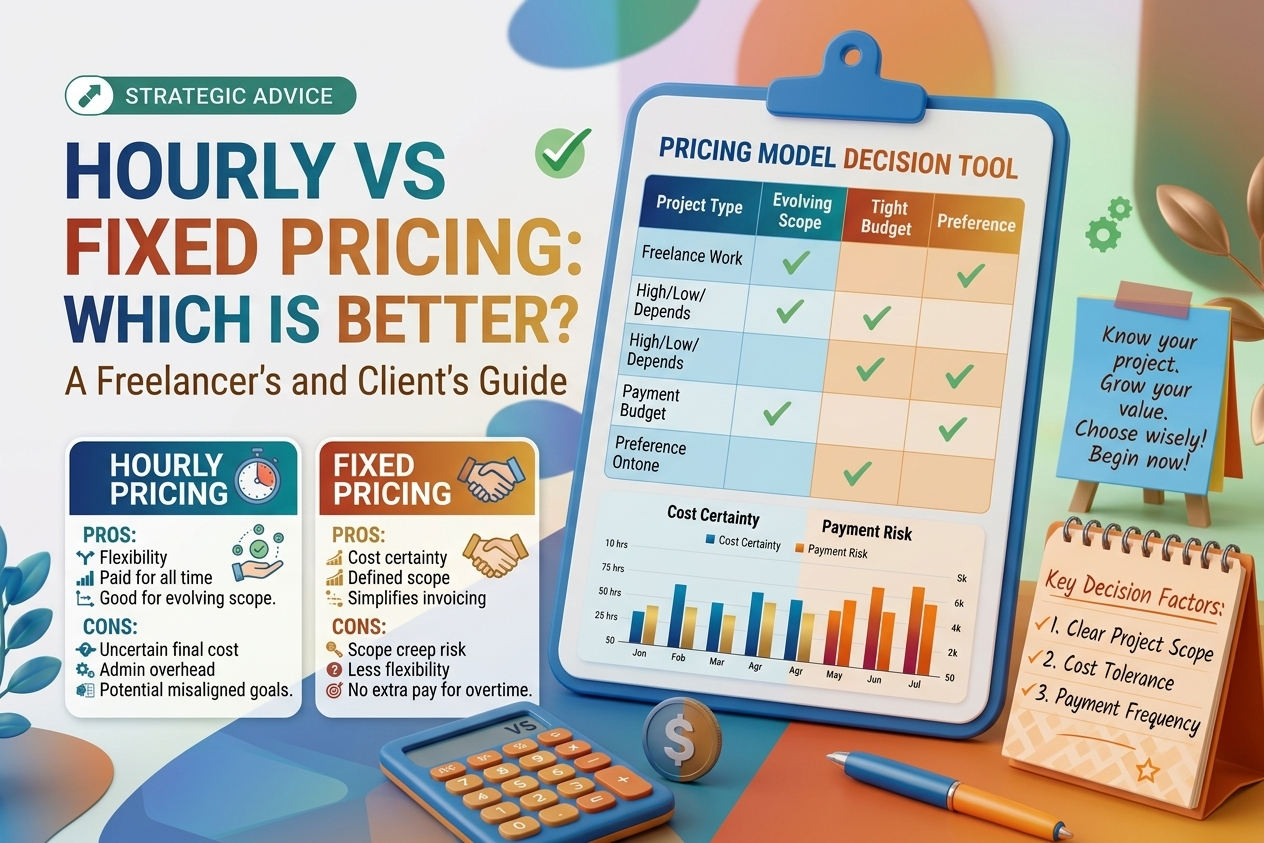
Hourly vs fixed pricing comparison table
| Factor | Hourly pricing | Fixed (flat rate) pricing |
|---|---|---|
| Best when | Scope is unclear, discovery-heavy, or evolving | Deliverable is clear and repeatable |
| Client risk | Cost can rise if hours rise | Budget is capped if scope is controlled |
| Your risk | Lower if you track time honestly | Higher if you underestimate hours |
| Cash flow pattern | Steady if billed weekly/biweekly | Often milestone or upfront + completion |
| Client preference | Mixed — some like flexibility, some fear open-ended cost | Often preferred for budget planning |
| Admin burden | Requires reliable time tracking and reporting | Requires strong scoping and change-order discipline |
| Reward for speed | Faster work earns less revenue | Faster work improves margin |
Hourly vs fixed pricing pros and cons
Hourly: pros
- Protects you when requirements change mid-project
- Easy to start when you cannot estimate accurately yet
- Transparent when clients want a detailed time record
- Fits retainers with variable monthly effort
Hourly: cons
- Clients may delay decisions because “the meter is running” creates anxiety
- You can be penalized for getting faster and better
- Weak time tracking silently destroys revenue
- Harder to productize your offer
Fixed / flat rate: pros
- Clear buyer decision: one number for one outcome
- Rewards process skill and templates
- Easier packaging (tiers, products, retainers with defined deliverables)
- Often smoother sales conversations
Fixed / flat rate: cons
- Scope creep can erase profit overnight
- Underquoting becomes a habit if you never track actual hours
- Clients may push for “just one more thing”
- Poor discovery leads to painful delivery
Flat rate vs hourly pricing examples
Abstract advice fails. Use these flat rate vs hourly pricing examples as patterns you can adapt — then rebuild the math for your market.
Pricing model example A: Freelance web design
- Hourly: $90/hour, estimated 40–60 hours, billed weekly with a time summary
- Fixed: $4,800 for a 5-page marketing site including 2 revision rounds
- Hybrid: $900 discovery (hourly capped), then fixed build fee after scope lock
If the client still does not know their sitemap, hourly or capped discovery protects you. If the sitemap and copy are ready, fixed is usually cleaner.
Pricing model example B: Consulting / coaching
- Hourly: $150/hour strategy calls as needed
- Fixed: $2,500 for a 4-week “offer and pricing teardown” with defined calls and a written plan
- Retainer (flat): $1,200/month for 2 calls + async feedback within 48 hours
Pricing structure examples for a small agency
- Project fixed fee by milestone (30% / 40% / 30%)
- Monthly retainer with a defined deliverable bundle
- Hourly overage rate for work outside the bundle
- Productized audit at a flat rate to start relationships
These pricing structure examples matter because “hourly vs fixed” is rarely the whole story. Mature firms stack models on purpose.
How to create a pricing model that survives real work
If you are asking how to create a pricing model, do not start with a competitor’s Instagram rate card. Start with economics and scope.
- Set a target effective hourly rate (what you need after taxes, tools, and non-billable time).
- List the work types you sell: discovery, delivery, revisions, support.
- Mark each work type as clear-scope or unclear-scope.
- Assign fixed fees to clear-scope offers and hourly (or capped hourly) to unclear-scope work.
- Write change-order rules before kickoff.
- Track actual hours on every engagement for 60–90 days.
- Adjust quotes using real data, not hope.
Example: A freelance developer quoted fixed builds using gut estimates and lost money twice. They tracked time for eight weeks, discovered average “small site” work was 18 hours over estimate, and raised fixed fees 25%. Same clients, healthier margin. That is how to price services as a freelancer with evidence.
Time data only helps if it is attached to clients and tasks. Time tracking that feeds invoices makes both hourly billing and fixed-fee audits easier — especially in Aenflow’s client → project → task → time → invoice flow. See freelancer workflows when you want that loop in one workspace.
Which one should you choose?
Use this decision filter. It is the section most comparison posts skip — and the one that actually helps you decide.
- Choose hourly when the problem is not fully defined, stakeholders change weekly, or you are entering a new service line.
- Choose fixed when deliverables, timelines, and revision limits can be written clearly before work starts.
- Choose hybrid when you need paid discovery first, then a fixed delivery phase.
- Choose retainer + overage when the relationship is ongoing but monthly effort varies.
Which pricing model is better for freelancers? The one that matches the project in front of you — not the one that feels fashionable this year.
Scenario — agency: A content agency sells “10 posts/month” as a flat retainer and bills hourly for rush campaigns. Clear package, clear overage. Conflict drops.
Scenario — solo consultant: Early discovery is hourly-capped. Implementation plan is fixed. Support is a monthly flat fee. That stack is often the best pricing strategy for small business advisory work.
Pricing strategies for services that protect cash flow
Model choice and cash flow are linked. Fixed fees with no deposits can starve you mid-project. Hourly billed only at month-end can create the same squeeze. Pair the model with payment timing.
- Fixed projects: deposit + milestone payments
- Hourly: weekly or biweekly invoices from tracked time
- Retainers: due at month start, not after delivery
- Always define what happens when invoices are late
If cash keeps getting stuck between delivery and payment, read how to fix cash flow problems in small business and tighten the billing loop — not only the rate card.
Best practices
- Write scope in outcomes, not vibes (“homepage redesign” is not a scope).
- State revision rounds and response times in the proposal.
- Track hours even on fixed projects — that is your pricing sensor.
- Review effective hourly rate after every project.
- Productize what you repeat; keep hourly for what you invent.
- Show clients options when it reduces fear (fixed package + hourly change requests).
Common mistakes
- Using fixed pricing with fuzzy scope and no change-order process
- Using hourly pricing with no time tracking discipline
- Copying a competitor’s rate without knowing your costs
- Discounting fixed fees instead of reducing scope
- Hiding the model from the proposal until after kickoff
- Never auditing whether your “profitable” fixed projects actually were
Step-by-step: pick a model for your next proposal (today)
- Write the deliverable in one sentence.
- List unknowns. If unknowns are many, choose hourly or capped discovery.
- If unknowns are few, estimate hours × target rate × risk buffer = fixed fee.
- Add payment schedule and out-of-scope rate.
- After delivery, compare estimated vs actual hours and update your template in Notion or your ops doc.
Frequently asked questions
Which pricing model is better for freelancers?
Neither is always better. Use hourly when scope is unclear or discovery-heavy. Use fixed (flat rate) when the deliverable is well defined and you can estimate reliably. Many freelancers mix both across project types.
What are hourly vs fixed pricing pros and cons?
Hourly protects you when work expands, but clients may fear open-ended cost. Fixed gives clients budget certainty and rewards your speed, but underestimation can erase margin. The better model is the one that matches scope clarity.
How to price services as a freelancer without guessing?
Start from your target effective hourly rate, estimate hours for a fixed fee, then add risk buffer for unknowns. Track actual hours after delivery and adjust the next quote. Data beats gut feel.
What is a simple pricing model example for a small agency?
Discovery hourly (capped), implementation fixed by milestone, and a monthly retainer for ongoing support. That hybrid is a common best pricing strategy for small business service firms.
Should I show flat rate vs hourly pricing examples to clients?
Yes — show options when helpful. A fixed package for a defined outcome plus an hourly rate for out-of-scope changes reduces conflict and keeps cash flow cleaner.
Conclusion: choose the model that matches the risk
Hourly vs fixed pricing is a decision about who carries uncertainty. Hourly keeps uncertainty on the client’s budget. Fixed keeps more uncertainty on your estimate — and rewards you when you are accurate and efficient. The winners are operators who can explain the tradeoff, write clean scope, and measure real hours.
For your next engagement, do not ask “What do other freelancers charge?” Ask “How clear is the scope?” Then choose hourly, fixed, or hybrid on purpose. That is how pricing strategies for services stop being guesswork.
When you are ready to connect estimates, tracked time, and invoices in one place, start a free Aenflow trial or see the demo. Related reading: business productivity methods, invoicing guides, and Aenflow pricing.