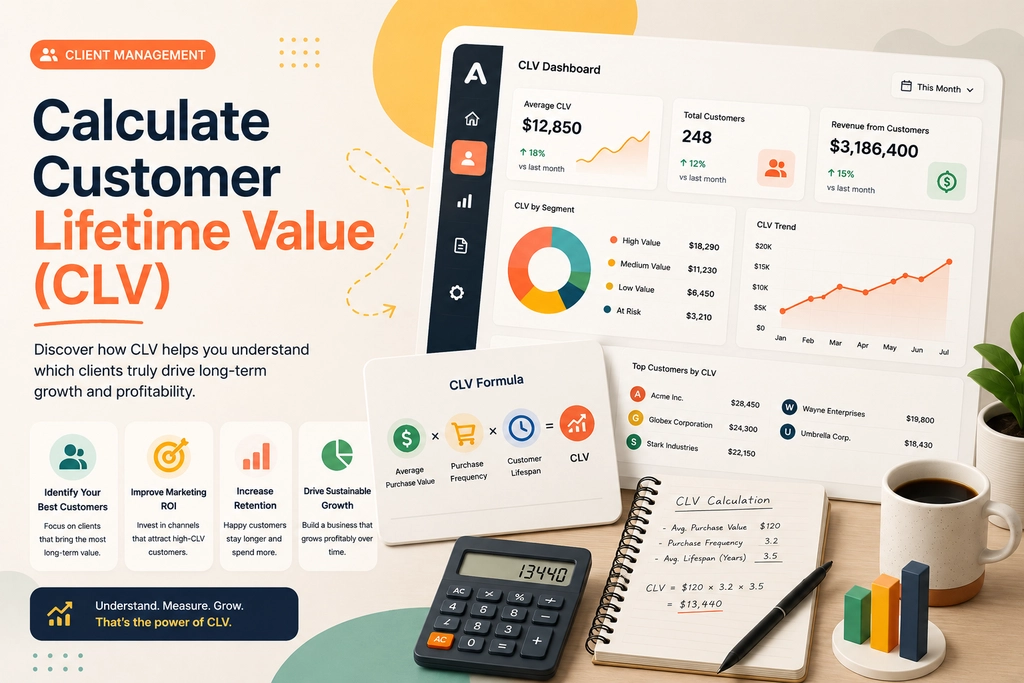
Most freelancers and agencies know their busiest clients. Far fewer know their most valuable ones. Customer lifetime value answers a sharper question: over the whole relationship, how much is this client actually worth after you pay for the work of serving them?
This complete guide covers what is customer lifetime value, how to calculate customer lifetime value with formulas that fit service businesses, and how to use lifetime value analysis to find your best clients. You will get step-by-step methods, worked examples (solo freelancers, agencies, retainers), and the advanced moves ranking articles often skip — like margin-adjusted CLV and segment models.
Search intent here is informational: people searching how to calculate CLV or customer lifetime value calculation formula want math they can trust, then decisions they can make. We stay practical for client work — not only subscription SaaS dashboards.
What is customer lifetime value? (Direct answer)
Customer lifetime value (CLV) — also called customer LTV, client lifetime value, lifetime value of a customer, or customer lifecycle value — is the total profit you expect from one customer across the entire relationship. The customer lifetime value definition is simple: revenue over time, minus the cost to acquire and serve them, for as long as they stay.
Customer lifetime value CLV definition in one line: how much one client is worth to your business for life, after costs.
Why customer lifetime value matters for freelancers and agencies
If you only look at the latest invoice, a loud client can look like a win while a quiet retainer client funds your rent. Customer lifetime value marketing and capacity planning both depend on seeing the full arc.
- Decide what you can spend to win a similar client
- Spot clients who create revenue but destroy margin
- Prioritize retention for high-CLV relationships
- Price packages and retainers with eyes open
- Stop treating every lead as equally valuable
Insight: A client who pays less per month but stays three years often beats a “big” project that burns your team and never returns. That is the point of lifetime value calculation.
Customer lifetime value formula (the models that matter)
There is no single sacred customer ltv formula. Pick a customer lifetime value model that matches your billing pattern, then keep it consistent.
1) Simple historical CLV (best starting point)
Customer lifetime value calculation for one client:
CLV = Total revenue from client − Total cost to serve client
Cost to serve includes your time (or team time), contractors, tools earmarked for them, and refunds. This is the cleanest how to calculate ltv of a customer method when you already have invoice history.
2) Predictive average CLV (portfolio view)
Customer lifetime value formula for a segment:
CLV = Average revenue per period × Gross margin % × Average customer lifespan (periods)
Example periods: months or years. This clv formula helps when you want a customer lifetime value calculation across many clients, not a single account autopsy.
3) Retainer / subscription-style LTV
Lifetime value formula for recurring work:
CLV = Monthly retainer × Gross margin % × Average months retained
If churn is steady, some teams use 1 ÷ monthly churn rate as average lifespan in months. Useful — only if your retention data is real, not hopeful.
4) Project-based freelancer CLV
How to calculate clv when you sell projects:
CLV = Average project value × Projects per year × Years retained × Gross margin %
This customer lifetime value calculation formula fits designers, developers, consultants, and coaches who return yearly without a formal retainer.
How to calculate customer lifetime value step by step
Follow this sequence. Do not skip margin — revenue-only “LTV” lies to service businesses.
Step 1: Pull client revenue history
- List each client and every invoice paid (not just sent)
- Note start date and last active date
- Tag client type (retainer, project, hybrid)
If invoices live in one workspace under each client, this takes minutes. Scattered PDFs make lifetime value analysis painful. Invoice management tied to client records keeps the raw numbers honest.
Step 2: Estimate cost to serve
- Sum tracked hours × your internal cost rate (or take-home target rate)
- Add contractor costs and client-specific tools
- Include revision spirals and unpaid “quick calls” if they are real
No time data? You are guessing CLV. Task-level tracking makes how to calculate customer lifetime value accurate — see best time tracking methods and time tracking on tasks.
Step 3: Compute historical CLV per client
For each client: revenue − cost to serve = client lifetime value so far. Sort the list. Your “best clients” often surprise you.
Step 4: Build a segment average (customer LTV model)
- Group similar clients (e.g., monthly retainers under $2k, project-only brands)
- Calculate average revenue per period and average lifespan
- Apply your gross margin %
- Use that as predictive customer lifetime value for new leads that look alike
Step 5: Compare CLV to acquisition cost
If winning a similar client costs $800 in ads, proposals, and discovery calls, and segment CLV is $1,200 at margin, the economics are thin. If CLV is $9,000, you can afford better outreach and onboarding. This is where customer lifetime value marketing becomes a budget decision, not a slogan.
Worked examples: lifetime value calculation in the real world
Example A — Solo freelancer (project clients)
Average project: $2,500. Typical client returns twice a year for 2 years. Gross margin after your time: 60%.
CLV = 2,500 × 2 × 2 × 0.60 = $6,000
That is what is customer ltv for this profile. A “$2,500 client” is really a $6,000 relationship if retention holds — useful when deciding how hard to pursue a lookalike lead.
Example B — Agency retainer
Monthly retainer: $4,000. Average stay: 14 months. Gross margin: 45% (team + tools).
CLV = 4,000 × 0.45 × 14 = $25,200
Now compare two prospects: one wants a $6,000 one-off; another fits this retainer profile. Without customer lifetime value, the one-off looks bigger. With CLV, the retainer wins.
Example C — High revenue, low CLV (the trap)
Client paid $18,000 last year. Tracked delivery cost (hours + contractors): $16,500. Historical CLV ≈ $1,500. Loud revenue, weak lifetime customer value. Raise prices, tighten scope, or replace the account. Cash pressure from these clients often shows up in cash flow problems even when “sales look fine.”
Advanced strategies: from CLV numbers to better clients
- Tier clients by CLV: A / B / C — give A clients faster response and proactive ideas
- Build offers for high-LTV patterns: if retainers outperform projects, productize the retainer
- Price with CLV in mind: see hourly vs fixed pricing when scope shape changes value over time
- Cut chronic low-CLV work: stopping a bad fit frees capacity for better lifetime value of a customer
- Use CLV in proposals: sell annual partnerships when the math supports continuity
Pattern interrupt: If your calendar is full and your profit is flat, you do not have a lead problem — you have a client mix problem. Lifetime value analysis is how you see it.
Keep a living CLV sheet in Notion for notes, but store the source of truth — clients, hours, invoices — in one system. Agency workflows in Aenflow and freelancer workflows help when every hour and invoice should roll up to a client before you calculate customer lifetime value.
Best practices for customer lifetime value calculation
- Always include margin or cost to serve — revenue-only LTV misleads
- Separate segments (retainer vs project) before averaging
- Update CLV quarterly as retention and rates change
- Use paid invoices, not optimistic pipeline
- Track time so cost-to-serve is evidence, not vibes
- Compare CLV to acquisition cost before scaling ads or outreach
- Review the bottom 20% of clients for scope, rate, or exit decisions
Common mistakes in lifetime value analysis
- Confusing revenue with value: big invoices can hide tiny CLV
- Ignoring unpaid admin time: “quick” calls are cost
- One blended average for all clients: hides your best and worst segments
- Using vanity lifespan: “clients stay 5 years” without data
- Never reconnecting CLV to delivery systems: if hours and invoices are scattered, the customer ltv formula is fiction
- Optimizing only acquisition: raising retention often lifts CLV faster than more leads
How to find your best clients with CLV (practical checklist)
- Export or list last 12–24 months of client revenue
- Attach hours and costs per client
- Compute historical CLV and sort high to low
- Write three traits your top CLV clients share
- Rewrite your offer and outreach to attract that profile
- Set a minimum CLV threshold for new custom work
That checklist turns what is customer lifetime value clv from a definition into an operating system for client management.
FAQ
Short answers on customer lifetime value, CLV formula, and how to calculate LTV of a customer:
What is customer lifetime value (CLV)?
Customer lifetime value (CLV), also called customer LTV or lifetime customer value, is the total net revenue you expect from one client over the full relationship — not just the first invoice.
What is the customer lifetime value formula?
A practical CLV formula for service businesses is: Average revenue per client × Average lifespan (in periods) × Gross margin. Simpler version: total revenue from a client minus delivery cost over their lifetime.
How to calculate CLV if I only have a few clients?
Start with historical lifetime value analysis per client: sum all invoices, subtract tracked delivery cost, then average your top and typical clients separately. You do not need thousands of customers to learn who is profitable.
Is client lifetime value the same as customer LTV?
Yes in meaning. Freelancers and agencies often say client lifetime value; SaaS and ecommerce teams say customer lifetime value or customer LTV. The math is the same — revenue over the relationship minus cost to serve.
How do I use CLV in customer lifetime value marketing?
Spend more acquisition effort on segments with higher CLV, create retainers for high-LTV profiles, and stop discounting for clients whose lifetime value cannot cover acquisition and delivery cost.
What is a good customer LTV formula for freelancers?
CLV ≈ (Average project value × Projects per year × Years retained × Gross margin). If you sell retainers, use monthly retainer × months retained × margin. Always subtract real hours — not hoped-for hours.
Conclusion
Customer lifetime value is the clearest way to see which relationships actually build your business. Learn the customer lifetime value formula that fits how you bill, run the calculation with real costs, and let the ranking change how you spend time, price work, and choose clients.
When how to calculate customer lifetime value becomes a quarterly habit — not a one-off spreadsheet panic — you stop chasing every lead and start growing the clients worth keeping.
If you want clients, tracked time, and invoices in one place before your next CLV review, start a free Aenflow trial or explore client management. Related reading: client management guides and invoicing.